
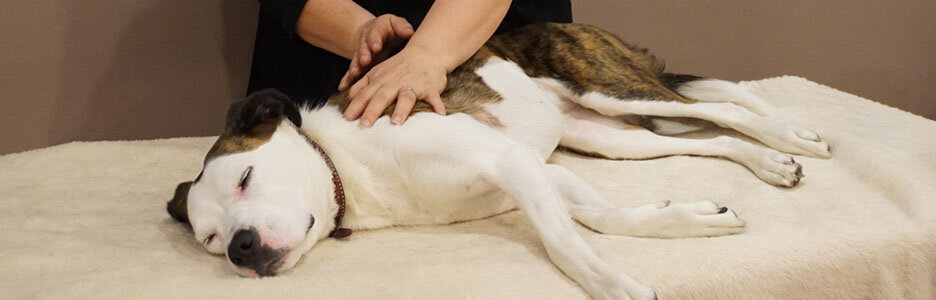
Physical Rehabilitation
Physical rehabilitation is not fun, but it is a very necessary component of the orthopedic healing process. Sometimes pets will show signs of pain after you complete a physical rehabilitation session, however, please know that this is normal. If you are hesitant to perform these treatments on your own, please consider professional physical rehabilitation.

It is important to minimize your pet’s activity in the weeks following their surgery. Avoid these activities until your pet has been approved for full activity by Dr. Simon at their final recheck appointment.
✘ No stairs (up to is okay)
✘ No running
✘ No jumping
✘ No rough housing with other pets
✘ Do not let your pet off the leash
Short on time?
Of course we always recommend following the full SVS rehab schedule, but check out this video for an abbreviated rehab session that can be used in a pinch.
Physical Rehabilitation Schedule
Be VERY CAREFUL with your pet during physical rehabilitation to avoid further injury and delays in healing.
Use this schedule after the following surgeries:
◼TPLO ◼CBLO ◼MPL ◼Fracture Repair
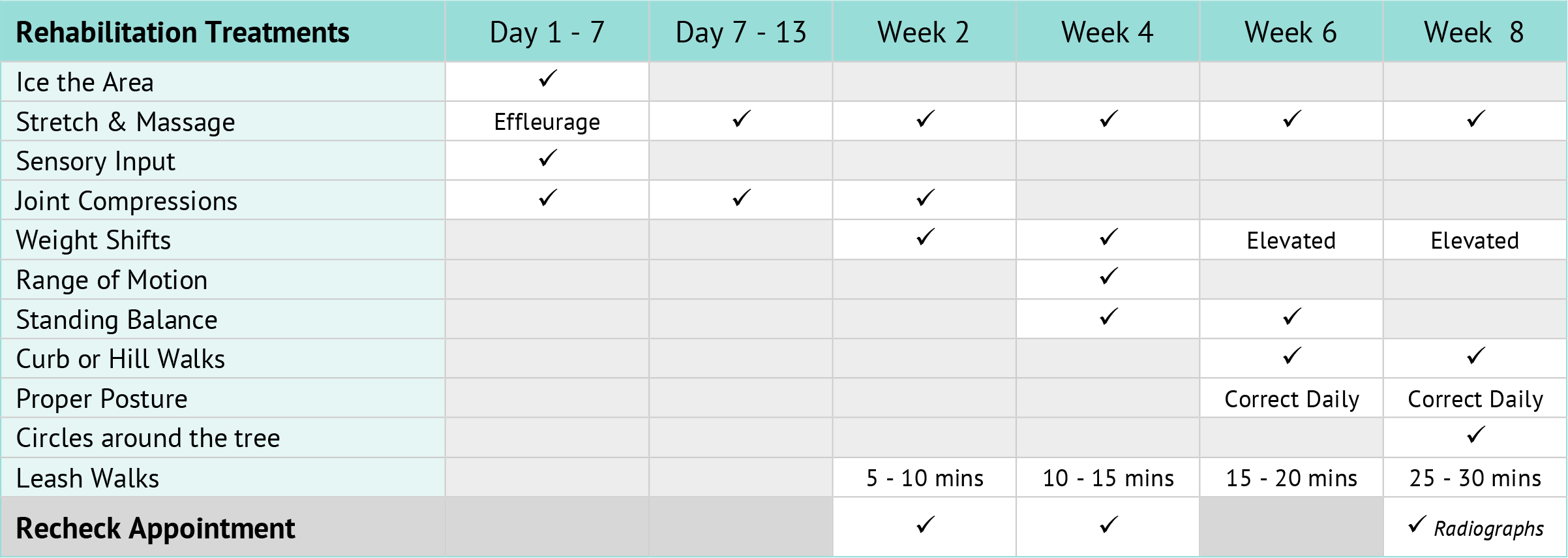
If cleared at the 8-week recheck, slowly resume your pet’s normal activity while continuing rehab, as full muscle strength can take up to 3–6 months.
Use this schedule after the following surgery:
◼FHO
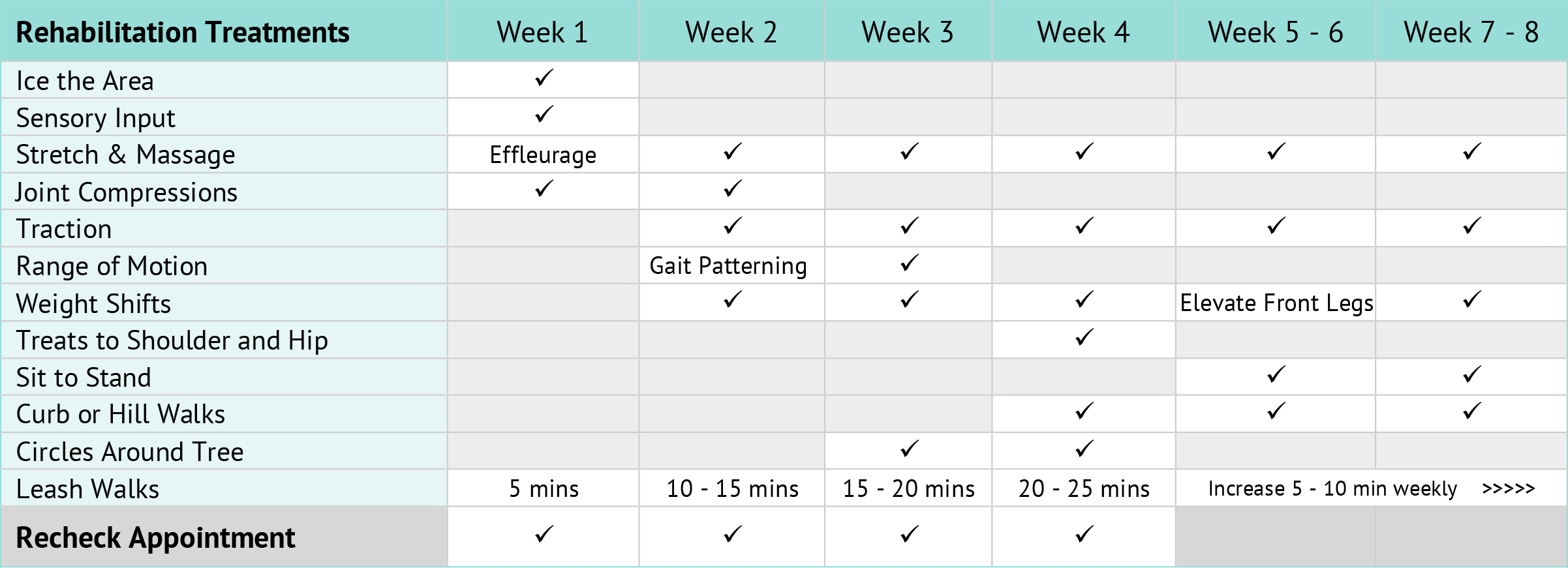
Your pet can resume full activity, if cleared, after the their 4-week recheck, but rehab is still essential during weeks 4 to 8.

Physical Rehabilitation Treatments
Ice the Area
🕑 2-3x/day
⌛ 5-10 minutes
Apply an ice pack to the affected area using a towel or pillowcase as a barrier. Do not allow the incision or stitches to get wet.
Effleurage: Use gentle, gliding hand strokes along the length of the muscle to promote circulation and reduce swelling.
Joint Compressions
🕑 2x/day
⌛ 10 seconds
Reps: 10
With your dog standing, gently press down the hip bones to create a soft “bouncing” motion to decrease swelling and pain.
Standing Balance
🕑 2x/day
⌛5 seconds
Reps: 3 | Sets: 3
Have your pet stand on a firm, non-slip surface. For easier practice, gently lift the opposite front leg; for more advanced practice, lift the dominant back leg. Hold for 3 seconds, gradually increasing time as tolerated. Do not force full weight bearing; focus on safe balance and confidence.
Sensory Input
🕑 2-3x/day
⌛30 seconds
Using your hand, gently brush or lightly tickle the affected limb and paw to promote sensory and body awareness. Movements should be light and slow.
Stretch and Massage
🕑 2-33x/day
⌛5 minutes
Stretch: With your pet lying down, gently flex and extend the affected hip/knee while supporting the leg and keeping it level with the body. Hold each stretch for 10–15 seconds then slowly move to the next stretch.
Massage: Gently rub upward, gradually increasing pressure. Use kneading strokes over the muscle belly to promote relaxation, flexibility, and reduce muscle tightness. Avoid the incision.
Weight Shifts
⌛15 seconds
Reps: 5 | Sets: 5
Have your pet stand on a firm, non-slip surface. Gently rock the hips side-to-side and front-to-back, encouraging balance. Do not force weight bearing on the affected leg; focus on safe, controlled movement.
Elevated Weight Shifts: For advanced practice, elevate the front legs on a step and gently rock the hips side to side. Progress by increasing height or using an uneven surface (cushion or mattress).
Range of Motion
🕑 2x/day
Reps: 5 | Sets: 2-3
Lay your pet on their side and support the affected leg with both hands. Gently bend and straighten the knee, then the hip, using slow, controlled movements.
Gait Patterning: With your pet standing, support the affected leg and gently guide it in a walking motion. Move slowly, allowing the paw to touch and slide across the floor.
Treats to Shoulder and Hip
⌛15 seconds
Reps: 5 | Sets: 3
With your pet standing, place one hand under the belly to prevent turning. With the other hand, hold a treat near the nose and slowly guide it toward the shoulder to encourage a stretch. Repeat, guiding the treat toward the hip. Perform on both sides. Keep all four paws on the ground—do not allow stepping or circling.
Leash Walks
Refer to the PT schedule for the current week of recovery and monitor your pet’s tolerance
Walk your pet on a short, controlled leash at a gentle pace to encourage use of the affected limb. Celebrate small successes with praise, and stop if they seem very uncomfortable or unwilling to continue.
Traction
Reps: 5 | Sets: 3
Lay your pet on their side. Support the hip with one hand and hold above the knee with the other. Gently pull the leg outward to stretch the hip, hold for a few seconds, then release.
Proper Posture
🕑 Correct daily
If your pet is leaning or holding a leg out to the side, gently reposition the legs under the body so they are sitting or lying evenly. A wall may help maintain proper posture. In some cases, this position may be behavioral and does not necessarily mean recovery is not progressing as expected.
Walking Backwards
Reps: 5 | Sets: 5-10 Steps
Hold a treat at your pet’s chest and slowly lower it so they follow it. Gently guide them backward, encouraging slow, controlled steps in reverse. Some pets find this hard—if yours does, tell us and we’ll adjust the exercise.
Curb or Hill Walks
⌛ 10-15 mins
While your pet is on a short, controlled leash, guide them slowly toward a curb, keeping the affected side closest to the curb, and encourage your pet to step up or down carefully. Move at a slow pace, allowing them to balance and adjust.
Circles Around Tree
2 minutes (5-8 circles twice a day)
Gently guide your pet in slow circles around a tree or pole, with the affected limb on the inside. This helps them use the limb consistently and gradually build strength..